
Leading-edge architectural films engineered for Japanese lamination systems, combining pristine surface clarity with exceptional mechanical resistance.


Established fundamentally with roots tracking back to 2005, Ganzhou Zhongyou Film Material Co., Ltd. has developed into a top-tier functional film manufacturer. Our ultra-modern production base integrates precision extrusion, multi-layer coating, optical curing, and cleanroom slitting to achieve flawless optical clarity and robust performance profiles.
Our dedicated research division focuses specifically on adapting advanced polymer structures like PETG, GAG, and specialized PET composites for the high-end cabinetry, prefab wall panel, and modular construction sectors of Japan. By keeping operations under rigorous quality control and strict ISO certifications, we supply materials that comfortably meet Japanese building code requirements (including formaldehyde emissions limits).
Connect With Our Technical Team
Analyzing the demand for high-end decorative films under Japan's unique construction trends, housing guidelines, and interior design movements.
In modern Japanese architectural centers like Tokyo, Osaka, and Fukuoka, space optimization dictates interior dynamics. High-rise residential complexes (Mansion) and upscale commercial offices require interior finishes that maximize ambient light reflection. Sparkling Silver High Gloss Films provide a premium, modern industrial aesthetic that aligns with contemporary minimalist trends.
Traditional lacquerware finishes require intensive manual labor and are cost-prohibitive for large-scale developments. Advanced PET and PETG multi-layer laminates simulate these deep, mirror-like metallic textures without the structural vulnerabilities of real metal panels (e.g., thermal expansion issues and excess weight).
Furthermore, the integration of Japandi (Japanese-Scandinavian) design elements calls for materials that balance organic visual textures with hyper-modern metallic contrasts. Sparkling silver accents on kitchen islands, vanity units, and commercial cladding achieve this visual balance.
Japan's Building Standards Act enforces strict controls on volatile organic compounds (VOCs) and formaldehyde release rates. Any decorative material installed inside residential or public spaces must be classified for compliance.
Key factors that global procurement managers, OEM furniture suppliers, and Japanese trading companies (Sogo Shosha) evaluate when selecting long-term extrusion partners.
For large architectural projects, a slight variation in the concentration of silver metallic pigments can result in visible seams. Our automated spectrophotometer systems verify consistent metallic orientation across production runs.
High-speed PUR flat lamination lines operate at high temperatures. High-gloss films must resist shrinkage and "orange peel" defects when subjected to polyurethane adhesives at 120°C.
Scratches during transit can compromise yield rates. We customize the peel tension (gf/25mm) of our surface-protective layers based on whether processing uses automatic vacuum presses or manual edge banders.
Understanding the transition from traditional PVC foils to environmentally friendly, high-performance GAG and PETG composites.
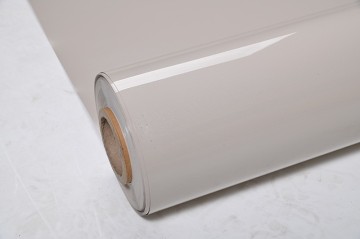
Our Sparkling Silver series features a co-extruded three-layer structure (GAG: PETG / APET / PETG). The core APET layer provides rigidity and impact resistance, while the outer PETG layers supply ductility and surface-coating compatibility.
The metallic silver pigments are suspended in a specialized polymer carrier to prevent oxidation. This ensures the film retains its brilliant reflectance over years of UV exposure, without yellowing or fading.
"By cross-linking high-density UV curable coatings onto the PETG substrate, our films achieve a pencil hardness rating of 2H+ while maintaining a gloss level exceeding 95%."
Utilizing high-purity PETG chips, blended with sub-micron metallic silver particles under controlled shear stress to ensure uniform flake orientation.
Ensuring flat thickness profiles across the width of the web (tolerances held within ±2 microns) to optimize automated roller coating steps.
High-energy curing processes fix the topcoat lacquer, locking in the finish characteristics (scratch, chemical, and fingerprint resistance).
On-line camera inspection detects surface contaminants down to 0.1mm². A protective film is laminated prior to slitting and packaging.
Enabling high-yield lamination, profile wrapping, and seamless edge banding for production departments.
Cabinet and furniture manufacturers in Japan often operate high-efficiency, automated flat lamination systems (such as Barberán or Friz lines). These setups demand uniform surface tension and reliable backside priming to ensure strong bonding with reactive polyurethane hot-melt adhesives.
Our film rolls undergo corona treatment, raising surface tension values to >40 dyne/cm. This prevents delamination along the edges of wrapped profiles, even under the humid summer conditions common in coastal Japan.
Direct technical answers for engineers, quality assurance managers, and global procurement departments.
PETG (Polyethylene Terephthalate Glycol) offers high ductility and scratch resistance, completely free of plasticizers and chlorine, making it highly recyclable. GAG is a co-extruded composite structure featuring an APET core sandwiched between PETG skin layers, optimizing raw material costs while maintaining the surface finish characteristics of PETG. PVC films contain plasticizers and chlorine, which release hazardous gases upon incineration. As a result, PVC is increasingly being replaced in high-end Japanese interior and cabinet programs.
Yes. Because our base films are extruded from premium, non-recycled PETG/PET resin without formaldehyde donors or organic solvents, they meet the most stringent formaldehyde emission requirements of the Japanese Ministry of Land, Infrastructure, Transport and Tourism (MLIT).
We use automated melt-blending loops with gravimetric feeding systems to ensure the concentration of metallic pigment is held within a ±0.1% tolerance margin. The design of our extrusion dies aligns the metallic flakes parallel to the film surface, reducing shade variations (ΔE) across the roll width to below 0.5.
For optimal bonding, maintain adhesive application temperatures between 110°C and 130°C. Press roller pressures should be set between 3 to 5 bars, depending on the density of the substrate (such as MDF or particleboard). Our back-side treatment is engineered to bond quickly with PUR adhesives, preventing edge curling and minimizing orange peel defects.
Custom color matching and laboratory sample generation typically take 7 to 10 days. Once the color sample is approved, bulk production is completed within 15 to 20 days. Shipments from our factory to major ports such as Tokyo, Yokohama, Nagoya, or Osaka generally require 5 to 7 days transit time.
Explore our full line of functional and aesthetic films engineered for home furnishings and architectural panels.
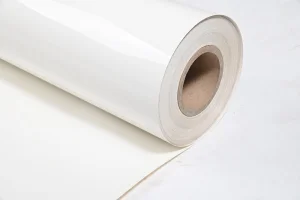
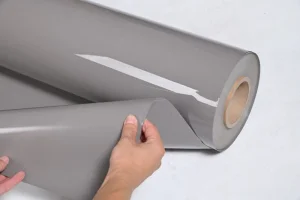
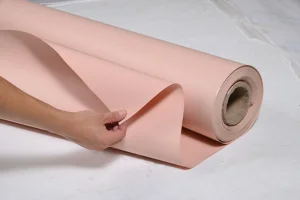
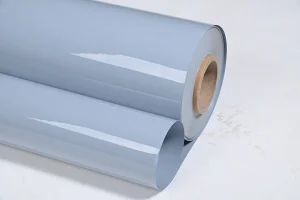
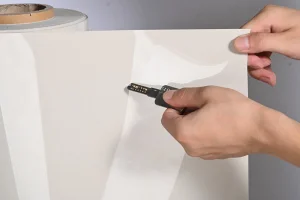
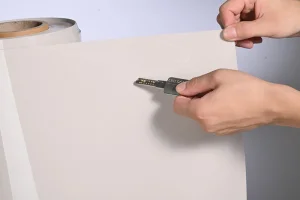
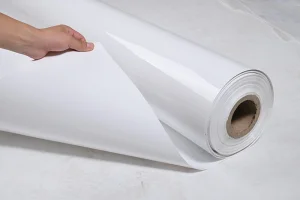
Consult with our engineers to request standard material samples (A4 sizes), custom color matching, and full physical parameter test reports.
Send Inquiry Now