
Choosing the right PET Polyester Film supplier is not a brochure exercise. It is a decision about consistency, process control, and the people behind each roll. A sample may look clear under office lights, yet behave differently on a fast converting line. Thickness variation, surface treatment, winding quality, and roll-to-roll traceability all deserve careful review. Small details matter.
Polymer-processing authority Dr. James L. White has written extensively about how processing affects polymer performance. The following is a practical paraphrase of that principle, not a verbatim quotation: “A film’s performance depends on how it is made, not only on how it is described.” For buyers, that means asking suppliers to explain their production controls and provide relevant test data. Useful checks may include thickness tolerance, tensile strength, haze, coefficient of friction, and treatment level. The right tests depend on the film grade and its intended use.
This guide outlines how to compare suppliers with evidence rather than promises. Review technical capability, quality documentation, lead times, communication, and support when a specification changes. Ask how the supplier handles an out-of-specification roll. Then check whether the answer is clear and documented. A polished sample is not enough. No supplier is perfect, and a short qualification process can still miss something. That is worth remembering. The goal is not to find a supplier with the strongest claims, but one whose performance can be verified over time.
Define the PET film’s job before comparing suppliers. Is it protecting a printed pouch, insulating electronics, or serving as a release liner? Each use needs different thickness, clarity, surface treatment, and mechanical strength. The Flexible Packaging Association’s 2023 State of the U.S. Flexible Packaging Industry report estimated industry sales at $42.9 billion in 2022, representing 21% of the U.S. packaging market. That scale does not make every film interchangeable. Small differences matter. Record the required thickness in microns, haze or transmission limits, tensile strength, and whether the film must accept printing, lamination, or coating. Standard PET is not automatically heat-sealable; specify a sealable grade or coating when needed.
Then define the conditions the film will face. Note operating temperature, humidity, contact with oils or solvents, winding tension, and the converting process. For packaging, set oxygen and water-vapor transmission targets rather than asking for “good barrier.” Request test methods and results, such as ASTM D3985 for oxygen transmission, so supplier data can be compared consistently. OECD’s Global Plastics Outlook (2022) reports that global plastics production rose from 234 million tonnes in 2000 to 460 million tonnes in 2019. This broad context makes end-of-life compatibility worth discussing, but it cannot determine whether a specific PET structure is recyclable locally. Ask for the film’s full layer structure and supporting test conditions. A common gap is specifying the film, but not the finished laminate. Test the actual stack.
A PET polyester film datasheet is a starting point, not proof of consistent production. Ask for recent, lot-specific results for thickness, tensile strength in both machine and transverse directions, haze, and coefficient of friction. ASTM D882 covers tensile properties of thin plastic sheeting; ASTM D1003 measures haze and luminous transmittance. The methods matter. Compare results only when sample conditioning, gauge, and test settings match. A clear film can still run poorly if its surface slips or blocks on a converting line.
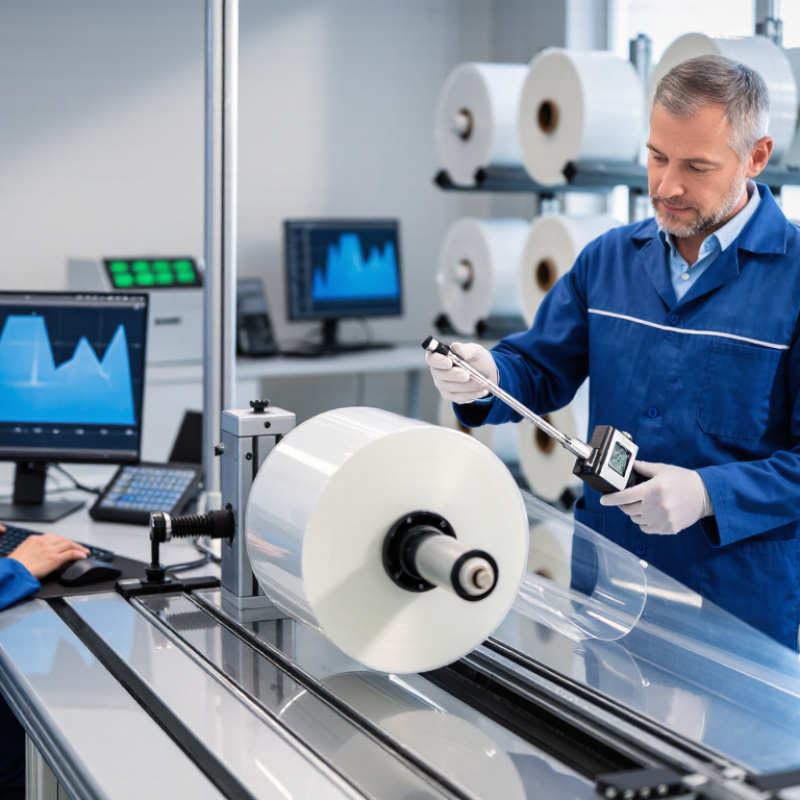
Check that the laboratory equipment is calibrated and that reports identify the test method, date, sample lot, and acceptance limits. Request a sample roll, then inspect its edges and measure thickness at several points. ISO 9001 certification can indicate a quality-management system, but it does not certify every film property. Verify certificate scope and validity. The OECD’s Global Plastics Outlook (2022) estimates that packaging generated 40% of global plastic waste in 2019, underscoring why traceable material specifications matter. One weakness remains: certificates rarely reveal lot-to-lot variation. Ask how the supplier tracks it, and whether results are available across multiple production runs.
How to Choose the Right PET Polyester Film Supplier?
Evaluate Supplier Expertise and Customization Capabilities
A capable supplier should explain how resin choice, stretching, and heat-setting affect film performance. Ask for specifications on thickness tolerance, tensile strength, haze, and surface treatment. Details matter. For example, a packaging line may need a specific corona-treated surface for ink adhesion, while an insulation application may prioritize dimensional stability. Request test methods and recent batch records, not just a polished data sheet.
Customization is more than cutting a standard roll to width. Check whether the supplier can adjust thickness, finish, roll diameter, and winding tension, then provide a trial roll for your own converting line. Ask how changes are verified between production lots. OECD’s Global Plastics Outlook (2022) estimated that global plastics production reached 460 million tonnes in 2019, with 353 million tonnes of plastic waste generated that year. The figures cover all plastics, not PET film, but they underline why yield, scrap control, and consistent processing deserve scrutiny.
Look for engineers who discuss trade-offs plainly. A thinner film may reduce material use, yet could increase handling issues on a high-speed line. Ask for sample testing under your actual temperature, tension, and printing conditions. Ask for evidence. I would also note any uncertainty: supplier data alone cannot predict every converter’s results, and a trial may expose problems neither side expected.
Recommended evaluation weighting for supplier expertise and customization capabilities
Technical expertise and customization receive the greatest emphasis because film performance depends on matching material properties and processing options to the application. These percentages are a suggested evaluation framework, not results from a market survey; adjust them to your project requirements.
A supplier’s quoted capacity is not the same as capacity available for your order. Ask for proof. Request monthly output for your film thickness, width, and surface treatment, plus current utilization and planned maintenance dates. Grand View Research’s Polyester Films Market report forecasts a 5.2% compound annual growth rate from 2024 to 2030. That points to a growing market, but it does not guarantee spare production slots. Ask whether your volume is reserved, and request recent on-time delivery figures for comparable orders.
Clarify lead time in writing. Does the clock start at purchase-order approval, artwork confirmation, or deposit receipt? Ask for separate dates for production, inspection, and dispatch. A useful quote names the delivery location and explains what could extend the schedule, such as custom slitting or a busy production window. Build in a small buffer. It may feel excessive until one shipment slips.
Compare commercial terms beyond price per kilogram. Check minimum order quantity, tolerances, payment milestones, freight responsibility, packaging, and claims procedures. Confirm how the supplier handles rolls with telescoping edges, uneven winding, or damaged cores. Request a sample specification and inspection record before approving a large run. One weak point in this process: buyers may compare quotes with different delivery terms. Recheck the assumptions side by side.
A PET polyester film sample is useful only when it matches the grade and production conditions you plan to buy. Request a sample with its thickness, surface treatment, and batch details recorded. Small details matter. Measure thickness at several points, inspect the edges for waviness, and check whether the roll unwinds evenly. For demanding applications, test haze, tensile strength, or surface performance using consistent methods. A clean sample is encouraging, but it cannot prove that every production run will be identical.
References help show how a supplier performs beyond a carefully prepared sample. Ask for contacts from customers using similar film thicknesses and applications. Keep questions practical: Were deliveries consistent? How were defects handled? Did specifications remain stable across repeat orders? Listen for specific examples, not just broad praise. Be specific. A reference list may be selective, so confirm each contact independently and compare answers with your own trial results.
Before placing a large order, document acceptance criteria and request a production-lot sample when possible. Compare it with the original using the same measurements and storage conditions. If results differ, ask for an explanation and supporting quality records. Not every variation signals a serious problem; measurement methods and handling can affect results too. That part is easy to overlook. Keep notes on findings, including small concerns, and agree on how both sides will investigate any future mismatch.
Ask for thickness tolerance, tensile strength, haze, and surface-treatment specifications. Request the test methods and recent batch records, not just a data sheet.
Test a sample under your actual temperature, line tension, and printing conditions. A treated surface may improve ink adhesion. Small trials can reveal surprises.
Ask whether the supplier can adjust thickness, finish, roll diameter, and winding tension. Request a trial roll in the size your converting line uses.
Request monthly output for your required thickness, width, and surface treatment. Ask about current utilization, maintenance dates, and whether your volume is reserved.
Confirm when the schedule starts, such as purchase-order approval or deposit receipt. Ask for separate production, inspection, and dispatch dates. Leave a small buffer.
Compare minimum order quantity, payment milestones, freight responsibility, packaging, and claims procedures. Check delivery terms carefully; quotes may not use the same assumptions.
Request a sample specification and inspection record. Ask how the supplier handles telescoping edges, uneven winding, or damaged cores. Get the process in writing.
Not completely. Film behavior can vary with equipment and operating conditions. I might still overcheck the records, but a real trial is more revealing.
Choosing the right Pet Polyester Film supplier begins with a clear understanding of how the film will be used and which specifications matter most, such as thickness, surface finish, clarity, strength, and performance in the intended process. Compare suppliers’ quality-control practices, testing methods, and relevant certifications to determine whether their products can consistently meet your requirements.
Next, assess each supplier’s technical expertise and ability to provide customized options. Consider production capacity, expected lead times, communication, and commercial terms alongside product quality. Before making a long-term commitment, request samples and evaluate them under real operating conditions. References and a review of past performance can also help confirm the supplier’s reliability. A balanced evaluation of product fit, service, consistency, and value makes it easier to choose a supplier suited to both current needs and future demand.
