
Choosing Pet Film For Whiteboard in 2026 requires more than comparing price and surface gloss. The film must suit the board substrate, writing tools, cleaning routine, and installation environment. A classroom may need strong stain resistance, while an office may prioritize low reflection during video meetings. Small differences matter. A practical evaluation should examine thickness, transparency, coating hardness, adhesion, and dimensional stability. Supplier technical data is useful, but it should not replace physical testing.
Start with a representative sample. Apply it to the actual board material, then write on it with several marker brands. Leave the ink for 24 hours. Erase it using a dry cloth, a microfiber pad, and the cleaner used by the customer. Look closely at ghosting, scratches, edge lifting, and color change. An experienced installer will also check bubbles under angled light. They can reveal poor wetting or uneven pressure. These details often disappear in a product brochure. That is the weak point.
For 2026 projects, buyers may also consider recycled content, low-emission adhesives, and verified manufacturing records. However, greener claims need evidence. Ask for test reports, batch consistency data, and clear warranty conditions. Do not assume a thicker film is automatically better. It may resist handling damage, yet create more installation difficulty. A reliable supplier should explain limitations, not only advantages. I have seen attractive samples fail after repeated cleaning, especially around corners. That mistake is easy to prevent. Test the finished system, not just the film. A careful selection process protects writing performance, appearance, and long-term maintenance costs.
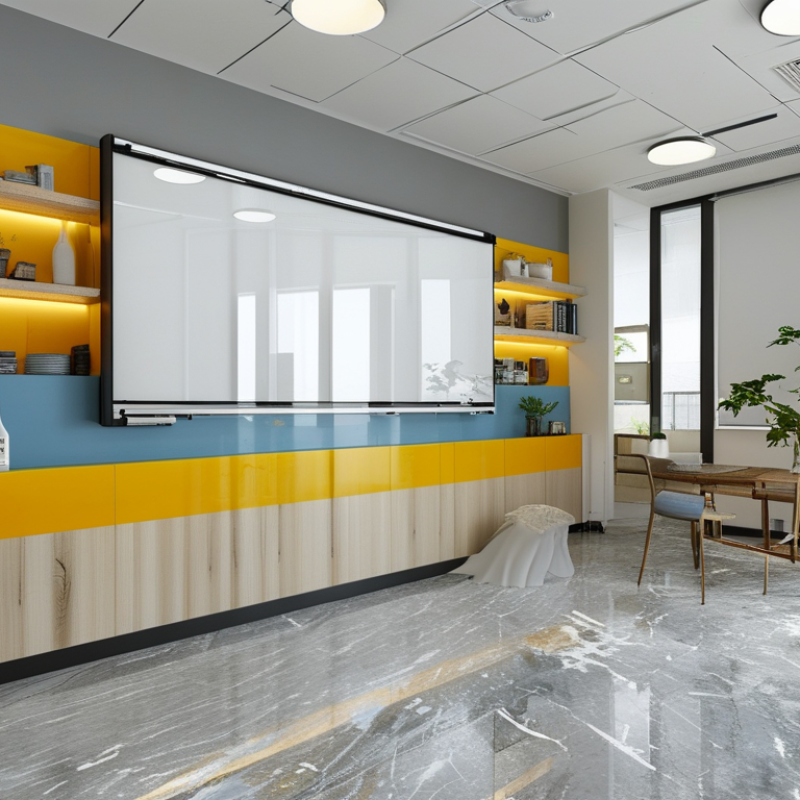
PET film means polyethylene terephthalate film, a clear, strong plastic sheet. In whiteboards, it often supports a dry-erase coating or printed surface. Its smooth structure helps markers glide across the board. It also resists tearing, moisture, and everyday handling better than ordinary plastic sheets.
A well-made PET whiteboard film should feel even under your fingertips. Look for low haze, stable thickness, and a surface that erases without leaving gray shadows. A classroom board may need stronger abrasion resistance than a lightly used office board. Check whether the film bonds firmly to steel, glass, or another backing material. Weak adhesion can create bubbles near the edges.
Thickness matters, but thicker is not always better. A very thick film may increase cost without improving writing performance. Ask for a sample and test several marker types, including red and black ink. Leave the writing overnight. Then erase it with a clean, dry cloth. This small test reveals ghosting, smearing, and coating weakness.
I would also inspect the film under bright side lighting. Small ripples can become distracting after installation. Surface claims deserve practical testing. No film is perfect. Temperature, cleaning habits, and installation skill can change results. In 2026, the safest choice is a PET film supported by clear technical data and repeatable sample testing.
| Selection Dimension | Typical PET Film Range or Requirement | Why It Matters for Whiteboards | Recommended Choice |
|---|---|---|---|
| Material identity | Polyethylene terephthalate (PET), a polyester thermoplastic film | PET offers a stable, smooth, lightweight substrate with good dimensional strength and surface clarity. | Use whiteboard-grade PET with a surface treatment or coating designed for dry-erase markers. |
| Film thickness | Commonly about 125–500 micrometres (5–20 mil); thicker constructions provide greater rigidity. | Thickness affects handling, flatness, impact resistance, curl control and the total weight of the panel. | Choose approximately 125–250 µm for flexible overlays and 250–500 µm for larger or more rigid panels. |
| Surface finish | Glossy, low-gloss or matte; lower-gloss surfaces generally reduce reflected glare. | Finish influences readability, lighting comfort, marker smoothness and ease of erasing. | Select low-gloss or matte for classrooms, meeting rooms and spaces with strong overhead or window lighting. |
| Dry-erase compatibility | Requires a non-porous, ink-release surface compatible with standard dry-erase markers. | Untreated PET may not provide the required ink release, cleanability or resistance to ghosting. | Require documented erase testing using the marker types intended for the finished board. |
| Opacity and whiteness | Opaque white PET or clear PET laminated to a white backing; optical values vary by construction. | A bright, uniform background improves contrast between marker ink and the writing surface. | Use opaque white film for single-layer designs and clear film when the backing supplies the visual white. |
| Dimensional stability | PET has relatively low thermal expansion compared with many commodity plastics; exact values depend on grade and orientation. | Better dimensional stability helps limit rippling, shrinkage and misalignment during lamination or temperature changes. | Choose a dimensionally stable, consistently oriented film for large-format boards and laminated products. |
| Tensile strength | Typical biaxially oriented PET film grades are commonly in the approximate range of 150–250 MPa, depending on direction and grade. | Strength supports resistance to tearing and handling damage, especially in thin flexible formats. | Use a higher-strength grade when the film will be rolled, repositioned or repeatedly handled. |
| Temperature resistance | PET has a glass-transition temperature near 70–80°C; continuous-use limits depend on grade, load and exposure time. | Temperature affects shrinkage, adhesion, curl and long-term dimensional performance. | Select a grade suitable for the highest storage, transport and installation temperature—not only normal room conditions. |
| Chemical and stain resistance | Generally resistant to water and many dilute chemicals, but compatibility varies with coatings, cleaners and marker solvents. | Incompatible cleaners can haze, swell or damage the dry-erase coating and may increase ghosting. | Test the complete surface with the intended cleaner, disinfectant and marker before production approval. |
| Surface hardness and scratch resistance | Depends mainly on the coating; uncoated PET is not automatically scratch-proof. | Scratches can trap ink, reduce gloss uniformity and make repeated cleaning more difficult. | Use a hard-coated or abrasion-resistant surface for high-frequency writing and cleaning environments. |
| Adhesion and lamination | May require corona, chemical or primer treatment to improve adhesion to adhesives, coatings or rigid substrates. | Poor bonding can cause bubbles, edge lifting, delamination and visible defects. | Confirm surface-energy, adhesive and lamination-temperature requirements with a finished-panel trial. |
| Indoor aging and UV exposure | Standard PET is suitable for many indoor applications; prolonged sunlight may require UV-stabilized construction. | UV exposure can contribute to yellowing, embrittlement or coating degradation over time. | Specify UV-resistant PET or a protective layer for boards installed near windows or in semi-outdoor areas. |
| Fire performance | Fire behavior varies by thickness, coating, adhesive and backing; PET film should not be assumed to meet a fire class without testing. | Commercial, educational and public interiors may have project-specific fire requirements. | Request test documentation for the complete whiteboard assembly where building regulations require it. |
| Recyclability and end-of-life | PET is widely recyclable in suitable streams, but coatings, adhesives, laminates and mixed materials can complicate recovery. | The sustainability profile depends on the entire board, not the PET layer alone. | Prefer mono-material or easily separable constructions and request recycled-content and end-of-life information. |
| Best-fit application | Flexible wall graphics, lightweight panels, laminated boards, glass overlays and portable writing surfaces. | PET can reduce weight and support printed, repositionable or custom-shaped whiteboard designs. | Match thickness, finish, coating and backing to the board size, installation method and expected writing frequency. |
: PET film is a clear, strong plastic sheet. It supports a dry-erase coating or printed writing surface. Markers glide smoothly.
Check haze, thickness, surface hardness, flatness, and chemical resistance. These properties influence contrast, scratching, erasing, and long-term appearance.
No. A thicker film may cost more without improving writing performance. Match thickness to handling needs.
A 100–150 micron film may feel stable on rigid panels. Thinner film can reveal dents, edge lift, or backing texture. Test the finished panel.
Write red and black marks on a sample. Leave them overnight. Erase them with a clean, dry cloth. Check shadows, smearing, and coating weakness.
A controlled matte finish can reduce glare. Excessive roughness may trap pigment in tiny grooves. Glossy surfaces erase easily but reflect ceiling lights.
Low haze usually creates sharper marker lines and stronger contrast. Inspect black text through the film under office lighting, not only beside a window.
Temperature changes may cause bubbles, curled edges, or distortion. Confirm dimensional stability during storage, transport, and installation.
Confirm that the film bonds firmly to steel, glass, or the backing material. Weak adhesion can create bubbles near the edges.
Not always. Real cleaning habits can expose weaknesses. Test several marker types and repeated wiping cycles. Small trials reveal more.
Choosing the right Pet Film For Whiteboard requires more than selecting a clear plastic layer. PET film provides a smooth, durable, and printable surface that supports easy writing, clean erasing, and attractive whiteboard designs. Key performance factors include thickness, dimensional stability, transparency, gloss or matte finish, scratch resistance, ink compatibility, and resistance to stains and chemicals. A thicker film may offer greater durability, while a thinner option can improve flexibility and reduce material use. Surface finish should be selected according to viewing conditions, writing comfort, and glare control.
Different applications may require different PET film specifications. Homes and classrooms often prioritize easy cleaning and low glare, while offices, meeting rooms, and commercial displays may need higher durability, improved clarity, or enhanced print quality. Before purchase, check film uniformity, adhesion, surface smoothness, and compatibility with whiteboard coatings and markers. It is also important to review safety documentation, responsible material sourcing, recyclability, and compliance with applicable environmental and product standards. A balanced evaluation helps ensure reliable performance, long service life, and a better user experience.
